The Humpback Super Highway

Finding My Way Back to the Wild in Mozambique

There are some trips you take because you want to see something extraordinary, and there are others that remind you why you need extraordinary things in your life in the first place. My ten days in Mozambique managed to do both.
I travelled with a small group of women, led by my friend Catherine Edsell, whose adventures have a habit of combining wild places with a purpose. Catherine and I have previously tracked elephants in the Namibian desert on behalf of EHRA (Elephant-Human Relations Aid), as part of her Matriarch Adventure, and monitored whale sharks off Mafia Island in Tanzania. So, when Catherine told me there was an opportunity to 'trial' a trip to Mozambique and spend time with Love The Oceans, a small charity working along the country's extraordinary eastern coastline, I was never going to need much persuading.
There were humpback whales, stand-up paddleboarding, sand dunes, seahorses and dancing harlequin shrimp ... but there was also a lesson in conservation that turned out to mean rather more than spotting the creatures we had travelled to see.
A Fire Break for the Soul
As someone who has, and continues to battle with anxiety, I often find I need to take time to reset. When work becomes too stressful and busy, caring responsibilities become a joyless burden, and the list of things to do plunges from manageable to neverending, I have to acknowledge that I'm heading into overwhelm.
Some might think putting your head down and battling through it is the best way to manage and cope, but I've learnt over many years that this doesn't always work for me. Like being caught in a rip if you float, save your energy and wait until the current to takes you out to sea it gives you precious time to gather your strength and swim back to shore. This trip would be me 'starfishing' and floating.
For me, heading somewhere wild is a chance to take a fire break, to step away from the noise, reconnect with the person I am underneath all the job titles and responsibilities, and remember what makes me feel properly alive. Adventure is my heartland - it's where I feel curious, challenged and restored. Adventure has always been my way of pressing pause.
This is why I travel with Catherine, she understands this, and creates the space to be present, away from the lifes distractions. Phones are 'banned', but in their place is presentness and connection. But, she also brings something extra to her trips. There is always an environmental project at the heart of our adventures. We don't simply turn up somewhere beautiful, tick off the wildlife and head home with a camera full of proof that we've been there. We get to understand something about the place, the people who live there and the challenges they face. This time, our destination was Mozambique's Wild Coast ... and wild it most certainly was.
The Humpback Super Highway
The coastline is a spectacular sweep of turquoise water and enormous terracotta sand dunes sculpted by the wind and spilling towards the Indian Ocean. Our mission was to get out on stand-up paddleboards and encounter humpback whales.

Every year, humpbacks migrate along the eastern coast of Africa, travelling between their warmer breeding and calving grounds and the colder, food-rich waters of the southern ocean. Mothers travel with their calves, often accompanied by another adult 'escort' along this Humpback Super Highway.
Humpbacks build up their energy reserves in feeding grounds before migrating, relying largely on those fat stores while travelling and breeding. They are generally fasting during this part of their lives, rather than feeding as they do in their summer feeding grounds. So, although humpbacks can use spectacular techniques such as bubble-net feeding to corral schools of fish, we weren't there to watch them gathering up a giant fish supper. Instead, we were there to witness a journey.

There is something wonderfully ridiculous about the idea of balancing on an inflatable paddleboard whilst a creature (possibly even three!) the size of a double decker bus passes through the water nearby. It's a reminder that, however adventurous we might like to think we are, we're very much guests in somebody else's world.
Unfortunately, we didn't get many close encounters with the whales. Our guide, Francesca Trotman, the founder of Love The Oceans, suspected that orcas might have been in the area, potentially scaring the whales away from this particular piece of water. Orcas are known to prey on young whales, although we couldn't know for sure that this was what we were seeing... or not seeing!

It was a useful reminder that wildlife doesn't follow our itinerary. We can travel halfway around the world, get up at some unholy hour and paddle about hopefully, but the ocean doesn't owe us a performance. The whales were making their own decisions, following their own ancient routes and we were lucky to be there.
Sometimes, the privilege is simply being alongside something extraordinary, even if it doesn't come close enough for the photograph you had in mind.
A world beneath the surface
Luckily, the whales weren't the only reason to get into the water - we snorkelled over reefs that Francesca and the team are working to protect, and I was reminded how easy it is to underestimate the complexity of a world that sits just beneath the surface.

We found seahorses clinging to seagrass in the shallow waters of a river estuary seemingly content to let the current do the work. Enchanting harlequin shrimp danced beneath a rock... and don't tell the capybaras, because they've now become my all time favourite animal!
The reefs, seagrass and marine life are not just beautiful, they're part of an interconnected ecosystem that supports fish stocks, livelihoods and the health of the ocean itself. But protecting that ecosystem isn't simply a matter of telling people to stop fishing, leave the reef alone or care more about whales.
When the ocean is both livelihood and threat
The eastern coast of Mozambique is a place of extraordinary natural beauty, but the sea is also incredibly dangerous. Powerful currents and rip tides can make entering the water perilous, and drowning is a very real risk. Every single family in the local community has been impacted by the loss of a loved one who has drowned at sea, often in the shallowest of waters closest to the coast.

For many people living here, the ocean is not an occasional playground or somewhere to escape to on holiday, it's where food comes from. It's how families earn a living and it's woven into daily life. Yet swimming is not a skill everyone has the opportunity to learn. It's a strange contradiction to encounter: people living beside an ocean they depend upon, but who may also have very good reason to fear it.
Francesca and the Love The Oceans team recognised something fundamental. You cannot simply arrive in a community and tell people to care about marine conservation if their relationship with the ocean is shaped by danger, uncertainty and the need to survive. Before you can expect someone to become an advocate for a coral reef, you need to understand their relationship with that reef. Before you can ask people to protect the sea, you need to consider whether they can enter it safely.

Conservation, I began to understand, is not just about protecting wildlife, it's about understanding people. This means looking beyond the immediate environmental problem to the social and economic realities that sit alongside it.
Meeting Pascoal & His Family
One of the most memorable parts of our trip was visiting Pascoal and his family, who live out in the bush. Travelling through the area, we passed roadside communities where everyday life unfolds close to the land and the coast. Small homes sit among sandy tracks and vegetation, with families making a living from what is available to them. The landscape is beautiful, but life here is not the easy, barefoot idyll that an outsider might imagine when looking at the beaches.
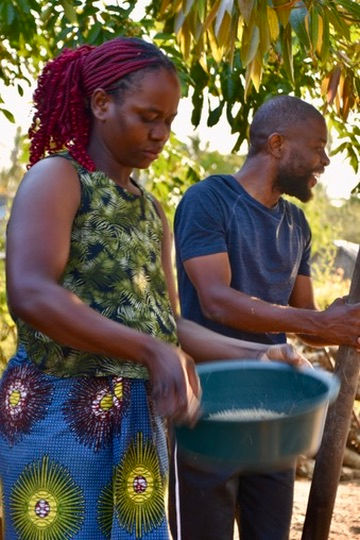
We were welcomed into Pascoal's world and given a glimpse of family life away from the visitor's version of Mozambique. It was a reminder that the places we travel to are not backdrops for our adventures, they are home.
Environmental challenges do not arrive neatly separated from everything else - they are part of the same complicated picture and that is why local leadership matters so much. People who understand their community, speak its language and know its realities can help bridge the gap between an environmental ambition and the changes needed to make it possible. Pascoal is a brilliant example of that.
As Love The Oceans' Community Outreach Manager, he works with local communities on ocean education, conservation and swimming programmes. He is not an outsider telling people how they should live, he is part of the community, helping people build the knowledge and skills to shape their own future.
From Learning to Swim to Teaching the Next Generation
Watching the swimming lessons set up by Love The Oceans was one of the most powerful parts of the trip. For those of us who grew up with swimming lessons as a fairly ordinary part of childhood, it can be difficult to appreciate what it means not to have that opportunity. We tend to think of swimming as a life skill, something children learn because it is useful on holiday or because their school runs trips to the local pool.
Here, it can be the difference between being able to respond in an emergency and being entirely at the mercy of the water. It can also be the difference between fearing the ocean and beginning to understand it.

Francesca and the team have recognised that swimming is not a side project to conservation, it's part of the solution. Children learning to swim are gaining a potentially lifesaving skill. They are also gaining confidence in the water and an opportunity to experience the marine environment in a different way. Alongside this, Love The Oceans works with local schools to teach children about marine life, ocean safety and the importance of sustainable fishing and protecting the ecosystems on which their communities depend.
The idea is beautifully simple: understanding can lead to connection, and connection can help inspire care.
Bento, another young man we met through the charity, came through the programme himself. He learned to swim, developed his skills and became involved in Love The Oceans' conservation work. He now supports the organisation as a field assistant, qualified swimming teacher and lifeguard, helping to teach more children to swim.
Pascoal, Bento and the wider Love The Oceans team are helping to build a environentally sustainable future, one conversation, one swimming lesson and one child at a time. To me this feels like a far more meaningful legacy than a few more people being able to identify a humpback whale.
Conservation is Complicated

Over ten days, our small group of women had come together with a shared appetite for adventure and the hope of seeing humpbacks. We came from different backgrounds, with different experiences and perspectives, but we were united by curiosity and a willingness to get out there and explore.
We paddled, we snorkelled and we searched (really hard!) for whales. We marvelled at tiny dancing creatures and enormous landscapes. We also learned about the realities of life on this stretch of coast, and about the complexity of trying to protect an environment that people depend upon for their survival.
There are no simple answers. Protecting marine habitats, sustaining fish stocks, keeping people safe and supporting livelihoods are all connected. You cannot pull one thread without affecting the others.
That is why the work of organisations such as Love The Oceans matters. Their approach recognises that successful conservation needs to involve the people who live alongside the environment, not simply the people who arrive to study or admire it.
It recognises that education is not just about giving people information. It is about creating opportunities for them to use that knowledge, develop new skills and become active participants in the future of their own communities. It's also about recognising the people already doing the work. The local champions who build trust, bring others along with them and turn an idea into something that can last.
We had travelled to Mozambique to see whales. We left with a deeper appreciation of what it takes to protect them.
The Heart of Adventure
I came away from Mozambique with sand in my socks and the familiar feeling that comes after a proper adventure: a slightly reluctant return to normal life, accompanied by a head full of new ideas I could apply to my roles in The Active Pregnancy Foundation and Girlguiding.
Had the fire break done its job? The to do is still impossibly long, but I had spent time in a wild, beautiful place, alongside women I enjoyed being with, doing things that reminded me why adventure matters so much to me. I had been able to step away from the everyday and reconnect with that curious, slightly restless part of myself that wants to know what is around the next corner.
This trip also reminded me that adventure can offer something beyond the experience itself. It can help us see a place differently and perhaps challenge our assumptions. It can introduce us to people whose work changes how we understand a problem. It can also remind us that the world is far more complicated, and far more interconnected, than we sometimes allow ourselves to believe.
I will remember the humpbacks and the Humpback Super Highway. I will remember the seahorses, the dancing shrimp and the vast dunes tumbling towards the sea. I will also remember Pascoal and his family. I will remember Bento, and the extraordinary journey from learning to swim to teaching children how to do the same.
I will remember the simple but powerful idea at the heart of Love The Oceans' work: that if we want people to protect the ocean, we need to help them build a safer, stronger relationship with it.
Conservation isn't just about saving something out there, it's about the people who live alongside it, the communities who depend on it and the next generation who will inherit it.
.... and sometimes, the most extraordinary thing an adventure can do is change what you think you came for in the first place.
Find out more about:
Pascoal in an award winning film - HERE
Bento features in this beautiful film - Peixinho (Little Fish)
A Note on AI - I've used AI to clean up and enhance some of the images featured in this blog - specifically the whale images and the shrimps.

Comments